.

.
The Living Life Series is dedicated to Lord Bo Tien (武天菩萨). The doctrine is in His image. The image is the doctrine. He who sees, understands and effects the doctrine sees and knows Him. He who does not see, know and effect the doctrine sees not and knows not the saint even if the saint or His image is beside him. The far may be near and the near may be far. Let the doctrine and the saint be part of our life. The lord saint in your life can be any heavenly saint of any religion, sect or school. The doctrine of truth is behind all and this is the Inner Truth that leads all (regardless of their religious affiliation or even if none) to inner peace and heaven on earth here and now and not just in the after life. The ideal worship and devotion is to know and effect the doctrine of God and the saints. The best gospel is the gospel of life. We learn from our life and the lives of others. The true temple is the world we live in. The sky is the roof of the temple and religions and sects are the pillars of the temple. All under Heaven are in the temple. Needless to say that all the saints we know are in this temple. Ji Gong Posat too is no exception. The whole wide world and web is the temple and must be regarded as a sacred place --- a temple for living and learning. It is more important that everyone that counts plays a role in this universal temple if due focus is to be given to the Mission of Heaven. Men must not be distracted by the agenda of men and end up serving the mission of man. That would be a far cry from the Mission of Heaven. We worship God and saints, not man however good that man may be. There should be no hero worshiping or idolizing of man whether he is a charismatic pastor, priest, monk, medium or lay leader. We don't even idol worship the image of any saint but reflect on what the image stands for. - the doctrine in the image. Omitofo 阿弥陀佛!.

Wednesday, May 20, 2015

What the Wesak flag means?

No  878 of Living Life Series 1

to know what the flag means
The flag bears the colors of 
the aura of the Buddha
The birth, the enlightenment and the ascent

On Wesak Day

From Wikipedia
The six vertical bands of the flag represent the six colors of the aura which Buddhists believe emanated from the body of the Buddha when he attained Enlightenment:
Blue (Nīla): Loving kindness, peace and universal compassion
Yellow (Pīta): The Middle Path – avoiding extremes, emptiness
Red (Lohita): The blessings of practice – achievement, wisdom, virtue, fortune and dignity
White (Odāta): The purity of Dharma – leading to liberation, outside of time or space
Orange (Manjesta): The Buddha's teachings – wisdom
The sixth vertical band, on the fly, is made up of a combination of rectangular bands of the five other colors, and represents a compound of the other five colors in the aura's spectrum. This compound color is referred to as Pabbhassara ('essence of light').

The flag must fly freely. The universal values the flag depict are for all and are free. They are common to all cultures. They constitute the inner truth behind all cultures. That is why all religions are one though different in their respective ways. This indeed is also the Inner Truth Message of the good lord Lord Bo Tien 武天菩萨
Lord Bo Tien 
武天菩萨


The Blue symbolizes the spirit of universal compassion for all beings.

The Yellow symbolizes the Middle Way which avoids all extremes and brings balance and liberation.

The Red symbolizes the blessings that the practice of the Buddha's Teaching brings. 

The White symbolizes the purity of the Buddha's Teaching and the liberation it brings. 

The Orange light symbolizes unshakable Wisdom of the Buddha's Teaching. 

The Combination Color symbolizes the universality of the Truth of the Buddha's Teaching. 


God and all rejoice             


Monday, May 18, 2015

The Buddha on the future Buddha

No 877 of Living Life Series 1
Yet another Wesak related article 
Let us know what The Buddha said on the future Buddha - on none other than on the day of his accent.  You can consider that as the event that gave rise to Wesak.
Below is from What Buddhists Believe by the late Ven Dr K. Sri Dhamananda. 
'I am not the first Buddha to come upon this earth; nor shall I be the last. Previously, there were many Buddhas who appeared in this world. In due time, another Buddha will arise in this world, within this world cycle.' 

When the Buddha was about to pass away, Ven. Ananda and many other disciples wept. The Buddha said, 'Enough, Ananda. Do not allow yourself to be troubled. Do not weep. Have I not already told you that it is in the very nature of things that they must pass away. We must be separated from all that is near and dear to us. The foolish man conceives his idea of Self; the wise man sees there is no ground on which to build the Self. Thus the wise man has a right conception of the world. He will conclude that all component things will be dissolved again; but the Truth will always remain.' 
The Buddha continued:' Why should I preserve this body when the body of the excellent law will endure? I am resolved. I have accomplished my purpose and have attended to the work set upon me. Ananda, for a long time you have been very near to me in thoughts, words and acts of much love beyond all measure. You have done well, Ananda. Be earnest in effort and you too will soon be free from bondages! You will be free from sensuality, from delusion, and from ignorance.' 

Suppressing his tears, Ananda said to the Buddha, 'Who shall teach us when You are gone?' And the Buddha advised him to regard His Teaching as the Master. 

The Buddha continued again:' I am not the first Buddha to come upon earth; nor shall I be the last. In due time, another Buddha will arise in this world, a Holy One, a Supremely Enlightened One, endowed with wisdom, in conduct auspicious, knowing the universe, an incomparable leader of men, a master of devas and men. He will reveal to you the same Eternal Truths which I have taught you. He will proclaim a religious life, wholly perfect and pure; such as I now proclaim.' 

'How shall we know him?' asked Ananda. The Buddha replied, 'He will be known as Maitreya which means kindness or friendliness.' 

Buddhists believe that those people who at present are doing meritorious deeds by leading a religious life will have a chance to be reborn as human beings in the time of Maitreya Buddha and will obtain Nirvana identical with that of Gautama Buddha. In this way they will find salvation through the guidance of His Teaching. His Teaching will become a hope of the remote future for everybody. 

However, according to the Buddha, devout religious people can gain this Nirvanic bliss at any time if they really work for it irrespective of whether a Buddha appears or not. 

'As long as my disciples lead a pure religious life, so long the world will never become empty of (saints) Arahantas.' - (Maha Parinibbana Sutta)
Discussion

There is great delivery and clarity by the late Venerable Dr K. Sri Dhamananda. In fact, it is a reality that anyone can be enlightened and even be saints or Buddhas to help others to salvation. 

To be enlightened, they need not be Buddhists or to belong to any culture, religion or sect. 

Sages of the various different religious cultures too may well be on the same path but at different levels of cultivation. People will want to see them as different.

It is as the late Venerable said a question if people really work for it - Nirvana. They don't even need to depend on a Buddha or to do so only when a Buddha appears. 

So why wait for a Buddha to do so? But do be graceful, to feel blessed by what The Buddha has put in place for us. But you do not necessarily need to idolize him or any sage but go for The Word for the Word is the Buddha and well, the Buddha is the Word. 

He has given us the legacy - the Word (doctrine); so will many other saviors in their respective ways big and small. The blessings of the aura of all Buddhas and saints will fly with us in life.
Put the Word into life - liven up the Word and be on the way. Buddha will be so pleased with you even if you don't know him. Otherwise why did the Buddha summed up the Doctrine or Word as this stanza below?

                                  Avoid evil
                                  Do good
                                  Purify the mind.
                                  This is the teachings of the Buddhas
                                          and indeed all saints

The good lord Lord Bo Tien 武天菩萨 echoes the same sentiments when he said that he is the Word and the Word is him. There is doctrine in the image and the image is the doctrine - telling us on the need to moderate and balance life - denial and indulgence as depicted by feet on two extremes or elements.
In fact, the Word represents or stands for all saints and all saints stand by the Word. The Word is introduced differently and in differing contexts by sages or saints of all religions and cultures. A rose by any name, color and size is still a rose.    
The future Buddha too can perhaps be in any culture. One cannot know for sure. The culture the historical Gautama Buddha got himself inserted into may well not be the same though similar in some ways as for the future Buddha as in the texts.

The teachings of all Buddhas transcend barriers. They are just integrated into and enrich existing culture. The teachings do not change culture or make people jump band wagon but they make people even better than what they are in their existing prevailing culture and belief-systems.  

People can stay what they are and though different in culture, they can be one at heart for the goodness of all beings and their liberation from woes of life. That goes without saying as one of the emphases of the future Buddha of the future in an ever more globalized future world. 
Let the world be more blessed by more sages and Buddhas as well as by more cultures. Cultures and religious institutions reach out to the far and together contribute to bring more to be near to the Word or Buddha nature.  

May we be blessed by more Buddhas and saints.  


Sunday, May 17, 2015

Why things happened the way they happened ?

No 876 of Living Life Series 1
This is a Wesak flagship article based on advice by Lord Bo Tien 武天菩萨 to believe and appreciate in context all religious cultures, sages and saints. 

Buddha is certainly worthy of belief and he even exhorts us not to believe out of faith but to test even his teachings like gold is tested by fire in the old days or by any means we know today. 

Know more and be better but do this in more complete and wholesome way even if we may not be perfect. It is the ideal that counts. We cannot arrive straight away. We need time. 


Many do think that anything about life was caused by actions in the past. Everything that happens happened because of something we did in the past. But the Buddha differs. There are five types of causal systems or orders at work that cause things to happen - the Five Niyamas. Karma is one of the five. 

1. Utu Niyama - physical inorganic order

Utu Niyama is about the system of how non-living matter operates. This is the system behind the change of seasons and phenomena related to climate and the weather. It explains the nature of heat, earth, water gases and wind. It explains disasters such as floods, earthquakes. Natural disaster is not due to karma and is not overridden by karma.  

2. Bija Niyama - physical organic order 

Bija Niyama is about system based on which living matter manifest and exist.  The Pali word bija means "seed," and so Bija Niyama governs reproductions and germination - the nature of germs and seeds. Plants and greenery come under this system not just animal and biological species. Perhaps, the laws of genetics that apply to all life, plant and animal would come under the heading of Bija Niyama. 

3. Karma Niyama - order of act and result 

Karma is the law of moral causation. All of our volitional or purpose directed thoughts, words and deeds create an energy that brings about effects, and that process is called karma. Karma Niyama is a kind of natural law, like gravity, that operates largely without having to be directed by a divine intelligence. In put it very simply, karma is the tendency for skillful (kushala) actions to create beneficial effects, and unskillful (akushala) actions to create harmful or painful effects. 

4. Dharma Niyama - order of the norm 

The word dharma has several meanings. It can mean doctrine and it can mean norms or phenomena. It often is used to refer to the teachings of the Buddha - the norms. But it also is used to refer to the manifestations or characteristics of reality or nature around us - such as imperfect, impermanent and insubstantial hallmarks of phenomena in life we know.  

5. Citta Niyama - order of the mind 

Chitta is "mind," and is driven by the heart. It is the state of consciousness. Citta Niyama is the system by which there will be mental activity. It has to do with consciousness, thoughts, and perceptions. 

We think of our minds as "us,"  and directing our lives. But mental activities too are phenomena in us that arise from causes and conditions, like other phenomena in universe outside our being. 
Discussion - The learning points

There are more than five sense organs and mind is the sixth sense organ. Thoughts are sense objects of the mind, in the same way the nose is a sense organ and smells are its objects. 

We want to go beyond the six sense organs to the vastness of reality or true light beyond the sense organs. Jhanas or pleasurable mental ecstasies (absorption) are sense objects of the mind and mind you, enlightenment is beyond mental ecstasies. 

But to many what they need is mindfulness so as to be at peace in the moment and many moments of peace will add up to more. Eventually, all will know mental ecstasy is still clinging and not the ultimate peace of the Buddhas and saints. It is still a form of sense pleasure. It is a refined non-physical indulgence of sorts.

Many have to go through the various stages of jhanas or mental ecstasies to attain the ultimate peace, for jhanas are attachments of the mind sense organ. But is it necessary? Some say so, as we need concerted focus or concentration and not just insight meditation to be Buddhas and saints. Without focus and convergence, how far can we go? We need balance of both focus and insight.  
On the occasion of Wesak, this post is motivated by and dedicated to the Buddha and adds to the wonders of the enlightenment and the great wisdom of the Buddha. 


Saturday, May 16, 2015

Wesak and freedom from the Three Hallmarks of Life

No 875 of Living Life Series 1


Wesak will always bring to mind the teachings of the Buddha. The joy of Wesak has to do with the Word of the Buddha. The Word is in the image and the image is the Word. This is what Lord Bo Tien 武天菩萨 said, didn't he?

Buddha advised all to grasp more on the three hallmarks of existence namely imperfection, impermanence and illusion of ego - dukkha, anicca and anatta in Pali. 

Impermanence is universal of existence be it on earth, hell or in the heavens.

Imperfection  is suffering. Birth, disease, old age and death are direct suffering. Worldly blessings do not last, add to the imperfection and suffering. What we are made of - the five aggregates are changing and not lasting. This too is imperfect.

Illusion of ego does not mean non existence or no self in every sense of the word but that we do not have ego or clinging. To put it bluntly, we need to cultivate a no-ego self and not be deluded into thinking we destroy ourselves nor mistake our five aggregates that make us sentient beings as the self or soul. 

Instead, we save ourselves by neither clinging on to the five aggregates as permanent entity nor thinking that we are no more if there are no five aggregates. 

The five aggregates that constitute a sentient being are matter, sensation, perception, mental formations and consciousness. 

We want to go beyond delusional clinging to aggregates and annihilation so that we no longer be at wits end. We need to end rebirths in all dimensions- in heaven, earth and in hell. We need to be free and be liberated to be enlightened beyond rebirths - to attain the non-caused, non-conditioned and non-created. 

We ourselves create the problems. We can put an end to these but this does not mean we finish ourselves. We liberate ourselves.

It is simple but not instant. We simply avoid evil, do good and purify the mind. We avoid negative mental roots of false views, ill-will (e.g. aversion, anger) and clinging (greed). We cultivate the opposite three positive roots of right views, goodwill and non-clinging. That is how we avoid evil, do good and purify the mind. 

Isn't this common sense? If so, then it is universal to all beings and all religious cultures? But with bad habit of attachment, we are blinded and see not the true nature and reality of life. This is the inner truth that the good lord Lord Bo Tien 武天菩萨 wants us to know so that we can be better at what we are and at where we are as well as in whatever culture we are in. 

Belief in God and saints is good but will not do if there is no common sense in going for what is real and necessary. The reality is we need to save ourselves by being good, avoid evil and purify the mind. 

Mere faith will not let us go the mile though we need faith and guidance. But let not our faith blind us and be our stumbling block. Remember the Word is in the image of God or saint and God or any saint is the Word. This the good lord Lord Bo Tien 武天菩萨 says not so that we believe only in him but so that we will believe and learn from all saints. 

Well, Wesak is about the Word and the Word is behind all religious cultures. Freedom from the Three Hallmarks of existence is what the Word is all about in any religious culture but the approach and presentation may vary and differ. 

There is no reason or excuse to split hairs at all. Humans often do but not God and saints. Humans may misrepresent God and saints but divinity don't seem to mind. 

God and saints are all about love. They are free from the three hallmarks... They will not take offence, let alone condemn. They love us ever the more and will help us - not spoil us and worsen our lot. All beings are brothers in God and saints. 
Lord Bo Tien 武天菩萨

Friday, May 15, 2015

Wesak and the other Four Truths of Life

No 874 of Living Life Series 1


The Buddha we knew when we were children is no different from the Buddha we know now for he is one and the same. He is the Buddha. But then in the old days, he was just what we expected him to be and we need only to keep to the five precepts of not harming and killing, no lying, no taking or stealing, no sexual misconduct and no intoxicants. 

In short, indeed we need only be good. It was that simple and uncomplicated then when we were innocent children. It  was nice to be simple and to be children. 
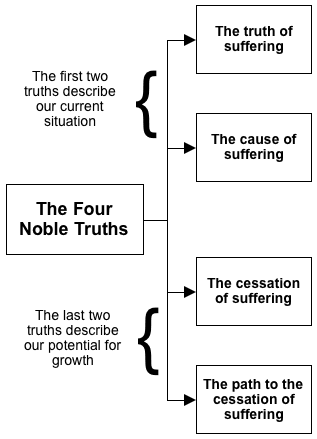
But with passing of decades, there is the need to know better the Four Noble Truths - the truth of imperfection or transient nature of worldly blessings in life causing us to suffer, the truth that there is the cause to this, the truth of what is the cause - ignorance and the three mental roots arising from it and finally, the solution or way out through eradication of ignorance. 
From there, with time the wonders of breaking this further into the Eight Fold Path will set the stage for more serious involvement in enlightened living even before enlightenment is any where near. 

The Buddha we knew is not the same as and yet is the same as the Buddha we know now. The Buddha will also be not the same and yet is the same as we move on in time.  

No wonder in connection with life and the hallmarks of life - impermanence, unsatisfactory insubstantial nature of life, the Buddha taught that an entity or thing is, it is not, it both is and is not and it neither is nor is not. 

The Buddha is the same, he is not the same, he both is and is not the same and he neither is nor is not the same. All four angles or perspectives are different and yet the same. This is to us the other Four Truths of Life that we need to know on life more so on Wesak Day.  

This four alternative truths of life apply to all aspects of life and we need to be mindful. It is perhaps why some Buddhists refer to the understanding that everything is nothing and nothing is everything. 

As extension, we can say with tongue in cheek that Jesus or Lao Tse is Buddha and Buddha is Jesus or Lao Tse. Yet we do know Jesus is Jesus, Lao Tse is Lao Tse and Buddha is Buddha. But they are one in saving souls. They are one in goodness for beings.

Buddha on his own is one though he means different things in different stages of our lives. Buddha and sages are one and yet different. They are one in basic teaching of oneness in goodness but yet different in effecting such goodness. 
Well, this calls to mind the reference by Lord Bo Tien 武天菩萨 that there is the near and there is the far. We can be far. We can be near say to Divinity. We are both near and far. In a way we are neither near and far. So much can be said for the near and the far that we need to know. 
Lord Bo Tien 武天菩萨

If after reading this post and finding the following meaningful, then you are enlightened enough to be on the way to enlightenment though not immediately and some way off.  It is a matter of time though...that gives peace of mind. 

We are

We are not

We both are and are not

We neither are nor are not.

These are the other Four Truths of Life we should reflect on Wesak Day. So what is the message? There is no permanence not even with ourselves as individuals.  

Where is there an unchanging self ? We are forever changing, aren't we? Not only is the body changing but the soul or the spirit of life too is changing. There is no unchanging self or entity in us. 

The lousy part is that we are actually changing faster for the worse though we are changing for the better. Perhaps, well just perhaps, we think we are changing for the better at least in the worldly but not the spiritual sense. This is the conventional way of thinking but not the ultimate reality. How many can go beyond conventional.

But to come to the point, there is need to be pure and stay off the impure aspects of self that are rooted in bad vibes of ignorance, ill-will and greed. We need to grow the purity of good mental roots of goodwill (that nurtures love for life), non-clinging and correct views. 

We need to love. Love must be unconditional. If love means hatred or bias towards some, then what love is that? There is more bad will than good will - more of dislike than of like for people in us. 

Well, this is not surprising as we somehow by force of wrong and lousy habits tend to grow more of the impure nature in us. It is high time we make the stand to be pure and good. 

There is no time to lose as time lost means flowing with polluted river of life and adding to the pollution. We need to stop pollution of life. We need to go upstream to the upper source for clear water. This unfortunately means we have to resolve to go against the downstream current - to go upstream. This the Buddha did by eating and not being ascetic as the norm then. He succeeded indeed and is the Buddha we know.

Going upstream against the conventional worldly ways the good lord Lord Bo Tien 武天菩萨 reminds us is the basic or inner teaching of all sages, more so the teaching of the Buddha. This is referred to as the inner truth common to all religious institutions and cultures by the good lord. This is the Inner Truth Message of the good lord.

Let all regardless of creed or culture rejoice in the various beautiful renditions of the same inner truth by none other than the great Buddha Gautama in addition to the renditions by other sages and saints. That way more will be saved - more souls if you like to use the word soul. 

By the way, the Buddha would never say he is the only Buddha or saint. He would never say we believe in him alone. He advised that we not believe in mere hearsay. In fact, he exhorted us to test what was supposed to be said by him like gold was tested by fire in the old days. That sums up the approach of the Buddha.